#include <clock.h>
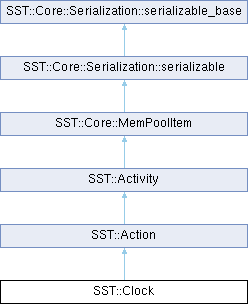
Data Structures | |
| class | HandlerBase |
| Base classes for clock handlers. More... | |
Public Types | |
| template<typename classT, auto funcT, typename dataT = void> | |
| using | Handler = SSTHandler<bool, Cycle_t, classT, dataT, funcT, HandlerBase> |
| Used to create handlers for clock. | |
| template<typename classT, auto funcT, typename dataT = void> | |
| using | Handler2 = SSTHandler<bool, Cycle_t, classT, dataT, funcT, HandlerBase> |
| Handler2 version which is now the same as Handler and is provided for backward compatibility until SST 17. | |
Public Member Functions | |
| Clock (TimeConverter period, int priority=CLOCKPRIORITY) | |
| Create a new clock with a specified period. | |
| void | schedule () |
| Activates this clock object, by inserting into the simulation's timeVortex for future execution. | |
| Cycle_t | getNextCycle () |
| Return the time of the next clock tick. | |
| void | updateCurrentCycle () |
| Update current cycle count - needed at simulation end if clock has run ahead of simulation end and to return correct cycle count in getNextCycle() for clocks that are currently not scheduled. | |
| void | registerHandler (Clock::HandlerBase *handler) |
| Add a handler to be called on this clock's tick. | |
| bool | unregisterHandler (Clock::HandlerBase *handler, bool &empty) |
| Remove a handler from the list of handlers to be called on the clock tick. | |
| void | registerHandler_restart (Clock::HandlerBase *handler) |
| Add a handler to this Clock object during restart. | |
| bool | isHandlerRegistered (Clock::HandlerBase *handler) |
| Checks to see if a handler is registered with this clock. | |
| void | registerGroup (Group *group) |
| Register a group with this Clock object. | |
| void | activateGroup (Group *group) |
| Activates a group that is inactive. | |
| std::string | toString () const override |
| Get a string represenation of the event. | |
| TimeConverter | getPeriod () |
| Get the period of the clock as a TimeConverter. | |
| Public Member Functions inherited from SST::Action | |
| bool | isEvent () const override final |
| bool | isAction () const override final |
| Public Member Functions inherited from SST::Activity | |
| void | setDeliveryTime (SimTime_t time) |
| Set the time for which this Activity should be delivered. | |
| SimTime_t | getDeliveryTime () const |
| Return the time at which this Activity will be delivered. | |
| int | getPriority () const |
| Return the Priority of this Activity. | |
| void | setOrderTag (uint32_t tag) |
| Sets the order tag. | |
| uint32_t | getOrderTag () const |
| Return the order tag associated with this activity. | |
| uint64_t | getQueueOrder () const |
| Returns the queue order associated with this activity. | |
| void | setQueueOrder (uint64_t order) |
| Set a new Queue order. | |
| virtual void | copyAllDeliveryInfo (const Activity *act) |
| Public Member Functions inherited from SST::Core::MemPoolItem | |
| void * | operator new (std::size_t size) noexcept |
| Allocates memory from a memory pool for a new Activity. | |
| void | operator delete (void *ptr) |
| Returns memory for this Activity to the appropriate memory pool. | |
| virtual void | print (const std::string &header, Output &out) const |
| Public Member Functions inherited from SST::Core::Serialization::serializable_base | |
| virtual const char * | cls_name () const =0 |
| virtual uint32_t | cls_id () const =0 |
| virtual std::string | serialization_name () const =0 |
Friends | |
| class | BaseComponent |
| class | Component |
| class | Simulation |
Additional Inherited Members | |
| Static Public Attributes inherited from SST::Core::Serialization::serializable | |
| static constexpr uint32_t | NullClsId = std::numeric_limits<uint32_t>::max() |
| Static Public Attributes inherited from SST::Core::Serialization::serializable_base | |
| static constexpr uint32_t | NullClsId = std::numeric_limits<uint32_t>::max() |
| Protected Types inherited from SST::Core::Serialization::serializable_base | |
| enum | cxn_flag_t { ConstructorFlag } |
| Protected Member Functions inherited from SST::Action | |
| void | endSimulation () |
| Called to signal to the Simulation object to end the simulation. | |
| void | endSimulation (SimTime_t end) |
| Called to signal to the Simulation object to end the simulation. | |
| Protected Member Functions inherited from SST::Activity | |
| void | setPriority (uint64_t priority) |
| Set the priority of the Activity. | |
| std::string | getDeliveryTimeInfo () const |
| Gets the delivery time info as a string. | |
| ImplementVirtualSerializable (SST::Activity) | |
| Static Protected Member Functions inherited from SST::Core::Serialization::serializable_base | |
| static void | serializable_abort (uint32_t line, const char *file, const char *func, const char *obj) |
Detailed Description
A Clock class.
Calls callback functions (handlers) on a specified period
Member Typedef Documentation
◆ Handler
| using SST::Clock::Handler = SSTHandler<bool, Cycle_t, classT, dataT, funcT, HandlerBase> |
Used to create handlers for clock.
The callback function is expected to be in the form of:
bool func(Cycle_t cycle)
In which case, the class is created with:
new Clock::Handler<classname, &classname::function_name>(this)
Or, to add static data, the callback function is:
bool func(Cycle_t cycle, dataT data)
and the class is created with:
new Clock::Handler<classname, &classname::function_name, dataT>(this, data)
In both cases, the boolean that's returned indicates whether the handler should be removed from the list or not. On return of true, the handler will be removed. On return of false, the handler will be left in the clock list.
◆ Handler2
| using SST::Clock::Handler2 = SSTHandler<bool, Cycle_t, classT, dataT, funcT, HandlerBase> |
Constructor & Destructor Documentation
◆ Clock()
| SST::Clock::Clock | ( | TimeConverter | period, |
| int | priority = CLOCKPRIORITY ) |
Create a new clock with a specified period.
References Clock(), and SST::Activity::setPriority().
Referenced by Clock().
Member Function Documentation
◆ activateGroup()
| void SST::Clock::activateGroup | ( | Clock::Group * | group | ) |
Activates a group that is inactive.
If group is already active, nothing is done. There is no need for a deactivateGroup() call as deactivation is only done based on return value during execute()
References schedule().
◆ getNextCycle()
| Cycle_t SST::Clock::getNextCycle | ( | ) |
Return the time of the next clock tick.
References updateCurrentCycle().
◆ getPeriod()
|
inline |
◆ registerHandler()
| void SST::Clock::registerHandler | ( | Clock::HandlerBase * | handler | ) |
Add a handler to be called on this clock's tick.
References SST::Output::fatal(), SST::Simulation::getSimulationOutput(), SST::Clock::HandlerBase::isActive(), SST::Output::output(), and schedule().
◆ registerHandler_restart()
| void SST::Clock::registerHandler_restart | ( | Clock::HandlerBase * | handler | ) |
Add a handler to this Clock object during restart.
References SST::Clock::HandlerBase::isActive(), and schedule().
Referenced by SST::Simulation::registerClock_restart().
◆ schedule()
| void SST::Clock::schedule | ( | ) |
Activates this clock object, by inserting into the simulation's timeVortex for future execution.
References SST::Activity::getPriority().
Referenced by activateGroup(), registerHandler(), and registerHandler_restart().
◆ toString()
|
overridevirtual |
Get a string represenation of the event.
The default version will just use the name of the class, retrieved through the cls_name() function inherited from the serialzable class, which will return the name of the last class to call one of the serialization macros (ImplementSerializable(), ImplementVirtualSerializable(), or NotSerializable()). Subclasses can override this function if they want to add additional information.
Reimplemented from SST::Activity.
References SST::Activity::getDeliveryTime(), and SST::Activity::getPriority().
◆ unregisterHandler()
| bool SST::Clock::unregisterHandler | ( | Clock::HandlerBase * | handler, |
| bool & | empty ) |
Remove a handler from the list of handlers to be called on the clock tick.
References SST::Clock::HandlerBase::isActive().
◆ updateCurrentCycle()
| void SST::Clock::updateCurrentCycle | ( | ) |
Update current cycle count - needed at simulation end if clock has run ahead of simulation end and to return correct cycle count in getNextCycle() for clocks that are currently not scheduled.
Referenced by getNextCycle().
The documentation for this class was generated from the following files:
- src/sst/core/clock.h
- src/sst/core/clock.cc